

How to keep stores, ecommerce and pickup in sync when connectivity is imperfect - and why architecture matters more than a generic “real-time” promise.

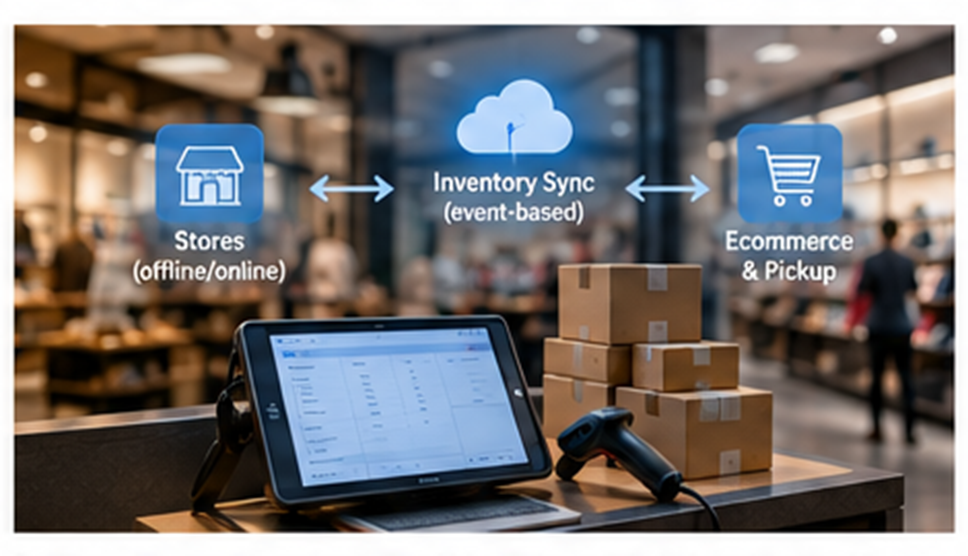
A resilient retail network lets stores keep operating locally while inventory changes move safely to ecommerce and pickup systems.
Retailers often talk about “real-time inventory” as if the problem were simply making numbers move faster. In a multi-location environment, speed is only one part of the job. The harder requirement is keeping the business trustworthy when a store has intermittent connectivity, a central service is delayed, or several systems disagree about what is available at a particular location.
A useful design starts with a less glamorous assumption: parts of the network will fail. Stores still need to sell, customers still need accurate ecommerce availability, and pickup promises still need to mean something. That pushes architecture away from one synchronous API call and toward local durability, event-based synchronization, explicit ownership of inventory state, and reconciliation after the fact.
Why multi-location inventory is more complex than ordinary channel sync
In a single online store, inventory may be adjusted by one commerce platform and one warehouse system. A physical retail network introduces many more writers and many more timing problems. A sale can reduce stock at the register while a return adds it back, a store transfer moves units between locations, a cycle count corrects a mismatch, and an ecommerce order reserves the same SKU for pickup.
The systems involved are rarely identical. POS, OMS, ERP, ecommerce, warehouse management and pickup services may each represent availability differently. Some work in real time, some in batches, and some only need to know whether inventory is trustworthy enough to make a customer promise. The architecture has to coordinate those differences without pretending that every location is permanently online.
·Store POS systems must continue processing sales, returns and local adjustments during short outages.
·Ecommerce needs a location-level availability signal, not only a chain-wide stock total.
·Pickup workflows need a reservation model that protects units promised to customers.
·Central systems need an auditable history of movements so they can reconstruct what happened after a gap.
·Operations teams need to know which stores are fresh, delayed or drifting before customers notice.
Five architecture patterns that make synchronization resilient
The most reliable retail designs tend to combine a small set of patterns rather than depend on a single product feature. A deeper technical breakdown of real-time inventory sync across retail store networks reaches the same conclusion: the store must be able to keep working locally while the center receives durable, replayable inventory movements.
1. Local transaction queue. A store records inventory-changing transactions locally before it considers the business action complete. If connectivity disappears, the queue keeps accumulating events rather than forcing the cashier to wait on a remote service.
2. Event-based synchronization. Instead of sending only the latest stock count, the store sends sales, returns, transfers and adjustments as movements. That preserves causality and gives the center enough information to replay or audit the change.
3. Idempotent processing. Every event carries a unique identity. If a retry sends the same movement twice, the receiving service recognizes the duplicate instead of subtracting the inventory a second time.
4. Freshness-aware channel rules. Ecommerce and pickup should know when a location has not reported recently. A stale store can receive tighter safety stock, a reduced pickup promise, or a temporary channel restriction.
5. Scheduled reconciliation. Real-time delivery reduces lag, but reconciliation is what reveals missing, rejected or inconsistent events. Both are necessary in a large network.
|
The key design
shift: treat inventory as a stream of accountable movements, not as one
number that every system is allowed to overwrite. |
Inventory truth is about ownership, not just latency
Teams often spend weeks debating milliseconds while leaving a more important question unanswered: which system is authoritative for which decision? A single global “source of truth” sounds simple, but it can become unrealistic in retail. The store may be authoritative for a completed local sale, while the OMS owns online reservations and the ERP owns financial posting. The goal is not to make every system identical; it is to define how their responsibilities intersect.
One practical model is to separate physical stock, reservations and available-to-promise. Physical stock reflects what the location believes is present. Reservations protect units committed to ecommerce or pickup orders. Available-to-promise is a channel-facing number derived from those inputs plus safety rules. This separation lets the retailer be conservative when data is stale without rewriting the physical count itself.
Design around partial failure, not total failure
Real outages are messy. One store may lose internet while neighboring stores remain healthy. The POS may reach payment services but not inventory. A regional cloud dependency may become slow rather than completely unavailable. Resilience therefore depends on recognizing partial degradation and deciding which workflows can continue safely.
|
Failure condition |
Technical control |
Business behavior |
|
Store cannot reach central inventory |
Local queue + last-known stock |
Store continues selling; online promise becomes more
conservative |
|
Event delivered more than once |
Idempotent consumer |
Inventory changes only once |
|
Events arrive out of order |
Sequence/version checks |
Later updates do not get overwritten by older ones |
|
Store has been stale too long |
Freshness threshold |
Pickup or low-stock ecommerce promises are restricted |
|
Counts disagree after reconnect |
Reconciliation workflow |
Mismatch is corrected and logged instead of hidden |
Ecommerce and pickup should respond differently to stale data
Not every channel needs the same confidence threshold. A home-delivery order fulfilled from a warehouse may be unaffected by a single disconnected store. A pickup promise for the last unit in that store is much riskier. Treating both situations with one availability rule creates either unnecessary lost sales or customer-facing failures.
A better approach is to make channel rules explicit. The system can continue exposing a comfortable quantity when there is a healthy stock buffer, while reducing or suppressing pickup when a store has been offline beyond a threshold. Fast-moving SKUs may use a larger safety buffer than slow-moving ones. The decision can also incorporate sales velocity, time since last sync, and whether the location is actively draining a backlog after reconnection.
Where the synchronization layer belongs
A common mistake is to push too much distributed-systems complexity into every store. Hundreds of mini event platforms are difficult to operate. The store generally needs durable local persistence, a clear outbound queue, compact retry logic and enough local state to continue the workflows that matter. The center is the better place for heavier routing, replay, dead-letter handling, analytics and cross-system fan-out.
This division also reduces operational risk. Store teams should not need to understand event brokers to recover from a connectivity problem. A store application should expose a few useful signals - queue depth, age of the oldest unsent transaction, last successful sync and local health - while central operations handles the network-level picture.
BOPIS is the fastest way to expose weak inventory assumptions
Buy online, pick up in store compresses the distance between a database record and a customer expectation. If the site says an item is available at Store 184, the customer assumes that specific unit can be collected there. A weak synchronization design becomes visible as canceled pickups, substitutions, manual searches and lost trust.
That is why pickup is a useful proof point when evaluating architecture. Zoolatech’s public same-day pickup enablement work shows how store-level inventory visibility can be tied directly to an omnichannel fulfillment experience rather than treated as an isolated reporting feed.
The engineering lesson is broader than one feature: inventory data becomes operationally valuable only when it can support a promise. The systems around it need reservations, freshness rules, clear exception paths and a way to recover after stores reconnect.
What to monitor once the system is live
A resilient system should make degradation obvious. If the only alert is a customer reporting the wrong pickup availability, the architecture is operating blind. Monitoring should answer both technical and business questions.
·How long has each store been disconnected from the central platform?
·How many inventory events are waiting locally, and what is the age of the oldest one?
·How many events are being retried, rejected or moved to a dead-letter path?
·How much inventory drift is found during reconciliation?
·How often are orders oversold or pickup orders canceled because location data was stale?
·How quickly can the network drain a backlog after a regional outage without overwhelming downstream systems?
Do not over-engineer the first version
The correct architecture depends on store count, sales volume, geography and the cost of being wrong. Ten stores on reliable managed connections may not need the same event backbone as 800 stores across regions with different connectivity quality. A packaged POS-commerce integration can be entirely reasonable for a simpler estate.
Custom synchronization becomes more compelling as the number of systems, locations and fulfillment promises grows. The trigger is not prestige; it is when native connectors can no longer express the business rules around reservations, offline operation, stale data and reconciliation.
A rollout checklist for enterprise retail teams
1. List every inventory-changing event: sale, return, transfer, adjustment, reservation, cancellation and cycle count.
2. Define which system owns each event and which systems need to consume it.
3. Document how long a store can operate offline and what data must survive a restart.
4. Assign a unique event identity and verify that replay is safe.
5. Define freshness thresholds for ecommerce and pickup separately.
6. Create a reconciliation process before go-live, not after the first mismatch.
7. Load-test reconnection so hundreds of stores can drain queued events without creating a second incident.
8. Give operations a dashboard that exposes store freshness, queue health and inventory drift.
9. Test customer-facing outcomes: overselling, failed pickup promises and substitutions, not only API latency.
The goal is graceful inconsistency, not magical consistency
A multi-location retailer cannot guarantee that every system knows the same inventory number at every millisecond. What it can guarantee is that the system behaves predictably when the network is imperfect: the store keeps selling, every movement is preserved, channels become conservative when data is stale, and the center reconciles the state when connectivity returns.
That is a more realistic definition of “real-time” retail. It is not the absence of delay. It is an architecture that contains delay, exposes it, and prevents it from turning into broken customer promises.